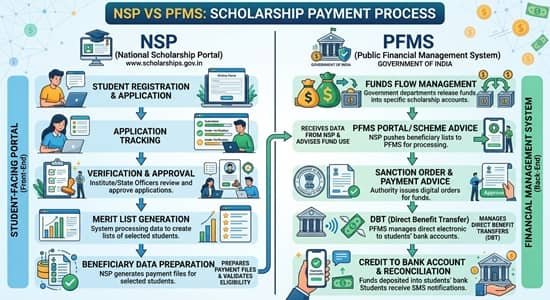
Which banks work with PFMS is a question most websites answer with a list that’s nearly a decade old. Many of those lists still name Allahabad Bank, Dena Bank, Vijaya Bank and other banks that merged out of existence in 2019 and 2020, along with regional rural bank names that changed in 2025. The good news is that the real picture is simpler than any copied list suggests. According to the Controller General of Accounts, PFMS is connected to the core banking systems of all public sector banks, all regional rural banks, major private sector banks, the Reserve Bank of India, India Post and cooperative banks. This guide gives the current names, explains why old lists mislead, and shows what “linked” actually means for you.

| Bank category | Number in India (August 2025) | Link with PFMS |
| Public sector banks | 12 | All integrated |
| Private sector banks | 21 | Major private banks integrated |
| Regional rural banks | 28 | All integrated |
| Foreign banks | 44 | Several large ones integrated |
| Small finance banks | 12 | Can receive government payments through NPCI where enabled |
| Payments banks | 6 | Can receive government payments through NPCI where enabled |
| Cooperative banks | Many | Integrated, per CGA |
| India Post | — | Integrated |
| Reserve Bank of India | — | Integrated |
Why Most PFMS Bank Lists Online Are Out of Date
The list circulating on many websites traces back to 2017-18, when the Ministry of Home Affairs published a list of PFMS-compliant banks for organisations holding FCRA accounts. At the time it had 53 banks. That list has been copied and re-dated year after year, even though Indian banking has changed a lot since then:
- Ten public sector banks merged into four in 2019 and 2020, so names like Andhra Bank, Corporation Bank, Oriental Bank of Commerce and Syndicate Bank no longer exist.
- Regional rural banks were consolidated in 2025, leaving 28 banks largely organised one per state, with new names.
- Citibank’s consumer banking business in India moved to Axis Bank in 2023.
- Many more banks have connected to PFMS since that first list, so a 53-bank list is far too short.
If a “2026 PFMS bank list” still shows Allahabad UP Gramin Bank or Vijaya Bank, it’s a recycled document.
Two Different Questions: Receiving Money vs Holding Scheme Funds
“Does my bank work with PFMS?” can mean two quite different things.
For individuals receiving payments: Almost any account that can receive NEFT, NACH or Aadhaar-based credits can receive a government payment processed through PFMS. Payments travel through NPCI and the banking network, so your bank doesn’t need its own special arrangement for you to get a scholarship or PM-KISAN instalment. What matters more is that your account is active, KYC-compliant and, for Aadhaar-based payments, correctly mapped.
For agencies holding scheme funds: Here the bank matters a lot. Scheme accounts need full integration with PFMS so balances, validations and payments flow automatically. Under the nodal account system, the main scheme account and all its zero-balance subsidiary accounts should be kept with the same bank, which is chosen when the nodal account is set up. An implementing agency can’t simply open a subsidiary account wherever it likes.
Public Sector Banks Linked With PFMS
All 12 public sector banks are integrated with PFMS:
- State Bank of India
- Punjab National Bank
- Bank of Baroda
- Canara Bank
- Union Bank of India
- Bank of India
- Indian Bank
- Central Bank of India
- Indian Overseas Bank
- UCO Bank
- Bank of Maharashtra
- Punjab & Sind Bank
Accounts from banks that merged in 2019 and 2020 now belong to one of these, so select the current bank name in any PFMS form.
Private Sector Banks
India has 21 private sector banks, and the major ones are integrated with PFMS. The banks below appeared on the government’s own list of PFMS-compliant banks, so their integration is well established:
- Axis Bank
- CSB Bank (formerly Catholic Syrian Bank)
- City Union Bank
- DCB Bank
- Dhanlaxmi Bank
- HDFC Bank
- ICICI Bank
- IDBI Bank
- IndusInd Bank
- Jammu and Kashmir Bank
- Karnataka Bank
- Karur Vysya Bank
- Kotak Mahindra Bank
- RBL Bank (formerly Ratnakar Bank)
- Yes Bank
In 2021, the government lifted its earlier restriction on private banks handling government business, allowing more of them to work with ministries and agencies. If your private bank isn’t on this list, it may well be integrated now; confirm with the bank or by checking whether it appears in PFMS’s bank selection field.
Regional Rural Banks After the 2025 Merger
All regional rural banks connect with PFMS through their core banking systems. After the 2025 consolidation, India has 28 RRBs, largely one per state, each sponsored by a larger bank. A few examples of the new names:
| State | Regional rural bank | Sponsor bank |
| Andhra Pradesh | Andhra Pradesh Grameena Bank | Union Bank of India |
| Bihar | Bihar Gramin Bank | Punjab National Bank |
| Gujarat | Gujarat Gramin Bank | Bank of Baroda |
| Jammu and Kashmir | Jammu and Kashmir Grameen Bank | Jammu & Kashmir Bank |
| Karnataka | Karnataka Grameena Bank | Canara Bank |
| Madhya Pradesh | Madhya Pradesh Gramin Bank | Bank of India |
| Maharashtra | Maharashtra Gramin Bank | Bank of Maharashtra |
| Odisha | Odisha Grameen Bank | Indian Overseas Bank |
If your passbook shows an older RRB name, your account now sits with your state’s merged RRB. Pick that name in PFMS forms.
Foreign, Cooperative, Small Finance and Payments Banks
Foreign banks. Several large foreign banks, including HSBC, Deutsche Bank, Standard Chartered and Abu Dhabi Commercial Bank, were integrated early, mainly for organisations and businesses.
Cooperative banks. PFMS connects with cooperative banks too, including several urban and state cooperative banks. Because cooperative banks vary widely in size and systems, it’s worth confirming with your branch before relying on one for an agency account.
Small finance and payments banks. Accounts in banks such as India Post Payments Bank can receive Aadhaar-based government credits when they’re enabled for it. Ask your bank whether your account is set up for Aadhaar-based DBT credits.
India Post. Post office savings accounts are part of the PFMS network and regularly receive pensions, wages and scheme payments.
How to Check Your Own Bank
- Look at the bank field on PFMS’s public tools. Type the first few letters of your bank’s name; banks that PFMS works with appear in the list.
- Ask your branch whether your account is enabled for NACH and Aadhaar-based government credits.
- For agencies, ask your programme division or nodal agency which bank holds the scheme’s nodal account, and open subsidiary accounts only with that bank.
FCRA Accounts Follow a Separate Rule
Organisations receiving foreign contributions have their own banking requirement. Since the FCRA amendment of 2020, the designated FCRA account must be opened at the State Bank of India’s New Delhi Main Branch. Older advice about keeping FCRA accounts only in “PFMS-compliant banks” comes from the 2017-18 period and has been overtaken by this rule.
FAQs
Q. Which banks are linked with PFMS?
All public sector banks, all regional rural banks, major private banks, cooperative banks, India Post and the RBI are connected with PFMS.
Q. Are all public sector banks integrated with PFMS?
Yes, all 12 public sector banks are integrated with PFMS.
Q. Can I receive a PFMS payment in a private bank account?
Yes, government payments can be credited to private bank accounts that accept NEFT, NACH or Aadhaar-based credits.
Q. Why do PFMS bank lists still show Allahabad Bank and Vijaya Bank?
They’re copied from a 2017-18 list and haven’t been updated after the bank mergers of 2019 and 2020.
Q. How many regional rural banks are there in India now?
After the 2025 consolidation, India has 28 regional rural banks.
Q. Can India Post Payments Bank accounts receive DBT through PFMS?
Yes, if the account is enabled for Aadhaar-based government credits.
Q. Can an agency open a subsidiary scheme account in any bank?
No, subsidiary accounts must be with the same bank that holds the scheme’s nodal account.
Q. Where must an FCRA designated account be opened?
It must be opened at the State Bank of India’s New Delhi Main Branch.