Credit through PFMS in a bank statement rarely appears in those exact words. It might read APBCR, APB CR, NACH CR, PFM CR, DBT, or a string of letters that looks like a scheme code someone typed in a hurry. Behind every version, the meaning is the same: a government office or agency sent money to your account using the Public Financial Management System as its payment channel. What the entry doesn’t always tell you is which scheme paid, why the amount is what it is, or whether it was meant for you. This guide decodes the common labels and shows you how to trace the source of any government credit.
| Label you may see | What it usually means | How it was routed |
| APBCR, APB CR, APBS CREDIT | Government benefit paid using your Aadhaar number | NPCI’s Aadhaar Payment Bridge System |
| NACH CR, ACH CR | Bulk credit using your account number and IFSC | NPCI’s National Automated Clearing House |
| NEFT CR with a government agency’s name | Direct transfer from a government or agency account | NEFT |
| PFMS, PFM or DBT in the narration | Payment processed through PFMS | Any of the above |
| Short scheme name or code | A specific scheme’s instalment or benefit | Any of the above |
| Labels vary by bank | The same payment can look different in different banks | Depends on bank’s statement format |
What the Entry Actually Tells You
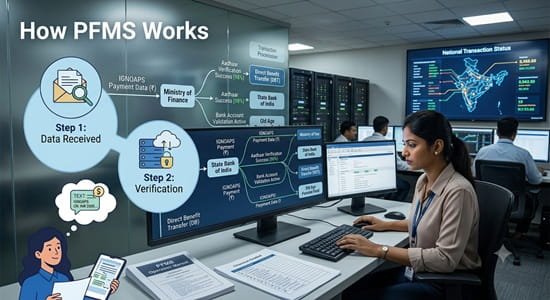
A PFMS-linked credit confirms three things:
- The money came from a government source, either a ministry, department, state agency or a body working on a government scheme.
- It travelled through official payment rails, so it was recorded at every stage from sanction to credit.
- Your account was valid for that payment, since PFMS won’t send money to an account that failed validation.
It doesn’t tell you:
- Which scheme it belongs to, unless the narration includes a code you recognise
- Whether more instalments are coming
- Whether the amount is final, since arrears or adjustments sometimes arrive separately
Why the Label Looks So Cryptic
Bank statements have short narration fields, and every bank formats them its own way. The paying side sends a description, the clearing system adds its own tags, and your bank trims everything to fit. The result is often an abbreviation like “APB CR” in one bank and “AADHAR PAY BRIDGE CR” in another for an identical payment.
Two practical consequences:
- Don’t judge a payment by its label alone. A missing “PFMS” tag doesn’t mean the money came from somewhere else.
- Look at the transaction reference. Even when the narration is unclear, the reference number lets your bank trace the payment fully.
Finding Out Which Scheme Paid You
When a credit appears and you’re not sure what it is, work through these steps:
- Note the date, amount and reference number from your statement or passbook.
- Match the amount to schemes you’re enrolled in. Fixed instalments are often recognisable at a glance, such as ₹2,000 for PM-KISAN.
- Check the PFMS payment record for that account using the public payment tool. Results generally show the scheme or paying agency against each credit.
- Look for an SMS from the scheme itself. Many schemes send their own message separate from the bank alert.
- Ask your bank branch for the remitter details of that transaction. Banks can see the originating account and paying institution even when the statement doesn’t show them.
- Check the scheme’s portal, where payment history usually lists each instalment with its date.
Government Payments That Commonly Arrive This Way
| Who receives it | Typical payment | Usual route |
| Farmers | PM-KISAN instalments, crop or input support | Aadhaar-based or account-based |
| Students | Central and state scholarships | Account-based or Aadhaar-based |
| Rural workers | MGNREGA wages | Aadhaar-based or account-based |
| LPG consumers | Cooking gas subsidy | Aadhaar-based |
| Elderly, widows, persons with disabilities | Social security pensions | Aadhaar-based or account-based |
| Central government employees | Salary and allowances | Direct transfer from the Pay and Accounts Office |
| Vendors and contractors | Payments for goods and services | NEFT or similar transfer |
| Businesses | GST refunds | Direct transfer after account validation |
An Unexpected Credit: What to Do
Sometimes a government credit lands that you weren’t expecting. Most of the time it’s legitimate: an arrear, a delayed instalment or a benefit you’d forgotten applying for. Still, it’s worth confirming before you spend it.
If it’s yours: Trace it using the steps above and keep a note of the scheme and date for your records.
If it seems to be a mistake: Inform your bank branch and the relevant scheme office in writing. Government schemes can and do recover amounts paid to people who weren’t eligible, and returning a wrong credit early is far simpler than dealing with a recovery notice later.
If someone calls asking you to return it: Be very careful. A common fraud pattern involves a caller claiming money was “sent by mistake” and asking you to transfer it back through UPI or to a personal account. Government departments don’t recover money this way. Any genuine recovery comes through official letters, your bank or the scheme office, never through a stranger’s phone call.
Is a PFMS Credit Taxable?
The PFMS label itself has no tax meaning. Whether the money is taxable depends on what the payment is for:
- Scholarships to meet the cost of education are generally exempt from income tax.
- Salary is taxable as usual, and tax is normally deducted before it reaches you.
- Payments to vendors and contractors count as business receipts.
- Welfare benefits depend on the scheme, so check the scheme’s rules or ask a tax professional if you’re unsure.
This is general information, not tax advice. For your own situation, a qualified tax professional can confirm how a particular credit should be treated.
Watch Out for Fake “Credited Through PFMS” Messages
Because people trust messages that mention PFMS, fraudsters copy the format. A few checks protect you:
- Verify in your bank statement, not in the SMS. If the credit isn’t in your account, the message is fake regardless of how official it looks.
- Check the sender ID. Genuine bank alerts come from your bank’s registered sender name, not a regular mobile number.
- Ignore links and call-back numbers in messages claiming a PFMS credit is “pending” or “on hold.”
- Never share OTPs or PINs to “receive” a payment. Receiving money never requires them.
FAQs
Q. What does credit through PFMS mean in a bank statement?
It means a government office or agency sent money to your account using the Public Financial Management System as the payment channel.
Q. What does APBCR mean in a bank statement?
It indicates a government benefit credited using your Aadhaar number through NPCI’s Aadhaar Payment Bridge System.
Q. Why doesn’t my statement show the scheme name?
Statement narration fields are short and each bank formats them differently, so scheme names are often shortened or left out.
Q. How can I find which scheme sent a PFMS credit?
Match the amount to your schemes, check the PFMS payment record for your account, or ask your bank for the remitter details.
Q. What should I do if I received a PFMS credit by mistake?
Inform your bank and the scheme office in writing, since schemes can recover amounts paid to ineligible people.
Q. Is money received through PFMS taxable?
It depends on the payment type; education scholarships are generally exempt, while salary and vendor payments are taxable.
Q. Can someone ask me to return a PFMS credit through UPI?
No, genuine government recoveries never happen through phone calls or UPI requests, so treat such calls as fraud.
Q. Does every government credit show “PFMS” in the narration?
No, many appear as APBCR, NACH CR or NEFT entries depending on the route and your bank’s format.