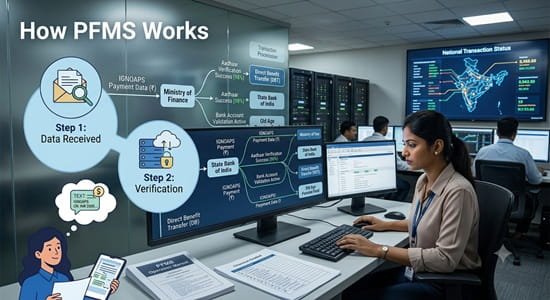
How PFMS works is easiest to see by following one instalment. Picture a ₹100 crore release of central share under a centrally sponsored scheme, meant for a state that shares costs 60:40 with the Centre. That single release must match a voted budget line, clear a Pay and Accounts Office, land in the state’s account at the RBI, be matched by roughly ₹66.67 crore of state money, and then trickle through district and block offices until it becomes thousands of small credits in people’s accounts. PFMS records every one of those hops, and some of its rules decide when the money is allowed to move at all.
| Particular | Details |
| Starting point | Budget provision approved by Parliament under a ministry’s Demand for Grants |
| Where a release begins | Sanction order generated on PFMS by the ministry’s programme division |
| Payment authorisation | Maker-checker approval with Digital Signature Certificates at the Pay and Accounts Office |
| Central sector schemes | Routed through a Central Nodal Agency (CNA) account |
| Centrally sponsored schemes | Routed through the State Treasury to a Single Nodal Agency (SNA), or drawn just in time under SNA-SPARSH |
| Common sharing patterns | 60:40 (Centre:State) for most states; 90:10 for North-Eastern and Himalayan states; 100% central for UTs without legislature |
| State treasury to SNA | Central share within 21 days of receipt |
| Matching state share | Within 40 days of central release |
| Instalment size (SNA model) | Not more than 25% of central share at a time |
| Trigger for next instalment | At least 75% of funds already released must be used, with state share transferred |
| Lower-level agency accounts | Zero-balance subsidiary accounts with drawing limits |
| Interest on scheme accounts | Remitted to the Consolidated Fund of India |
| Final credit routes | NPCI (Aadhaar-based) or account-based bank transfer |
| Reconciliation | Bank e-scrolls matched against payments in PFMS |
Step One: Money Has to Be Voted Before It Can Move
Nothing flows through PFMS until Parliament has approved it. Each year, ministries present their Demands for Grants, and once the Appropriation Act passes, the approved amounts are loaded into PFMS against specific budget heads.
From then on, the budget acts as a ceiling. A programme division can generate a sanction order on PFMS only up to the provision available under that head, so overspending gets stopped at the screen rather than discovered in an audit months later. The sanction order is the starting document for everything that follows. It names the scheme, the recipient, the amount and the budget head it’s charged to.
Inside the Pay and Accounts Office: Turning a Sanction Into a Payment
A sanction is a promise. The Pay and Accounts Office turns it into money.
Once the sanction arrives, the PAO checks it against rules and available budget. Approval works on a maker-checker basis: one official prepares the payment, another reviews and authorises it, and both sign digitally with their Digital Signature Certificates. No paper cheque is involved.
The authorised payment goes electronically to the bank accredited to that ministry. The bank pays the recipient and debits the government’s account. It then sends an electronic scroll back, listing every transaction it processed. PFMS matches that scroll against its own payment records, which is how a ministry’s books get reconciled without someone ticking entries by hand.
Three Routes the Money Can Take
What happens after the PAO depends on the kind of scheme.
| Route | Used for | Where funds sit before use | Who draws them |
| CNA model | Central sector schemes (fully funded and run by the Centre) | Central Nodal Account in RBI (TSA) or an authorised bank | Sub-agencies within drawing limits |
| SNA model | Centrally sponsored schemes (shared with states) | Single Nodal Account opened by the state for each scheme | Implementing agencies within drawing limits |
| SNA-SPARSH | Notified centrally sponsored schemes | The RBI, until a payment falls due | State treasury on a just-in-time basis |
Central Sector Schemes: The CNA Route
Each ministry names a Central Nodal Agency for every central sector scheme, and the agency holds one account for it. Larger schemes keep this account within the government’s own treasury system at the RBI. Schemes with an annual outlay below ₹500 crore, or those run through state agencies, can use an account at a scheduled commercial bank instead.
Agencies further down, called sub-agencies, don’t receive transfers of their own. They’re given the right to spend from the CNA account up to a set limit.
Centrally Sponsored Schemes: Treasury, Then SNA
Back to the ₹100 crore instalment. Under the SNA model, it lands first in the state government’s account at the RBI. The state then has 21 days to move it to the scheme’s Single Nodal Account, and 40 days from the central release to add its own share, about ₹66.67 crore at 60:40. For a North-Eastern state at 90:10, the matching share would be around ₹11.11 crore.
PFMS enforces the first deadline in a practical way. If an earlier instalment hasn’t reached the SNA account from the state treasury, the system won’t generate a sanction for the next one. The state’s own pace decides how quickly it receives more.
SNA-SPARSH: Money Stays at the RBI Until a Bill Is Ready
Under SNA-SPARSH, the ministry issues a sanction on PFMS that sets the scheme’s entitlement for the state, but the cash doesn’t move in advance. When an implementing agency has a real payment to make, it raises a bill through the state’s treasury system. The treasury then draws the central and state shares together, through the RBI’s e-Kuber platform, and pays.
The practical effect for the state: no parking period and no 21-day transfer step, because there’s nothing sitting in a bank account to transfer.
Zero-Balance Accounts: How a Block Office Spends Without Holding Money
This is the part of the system that surprises newcomers most. A district health office or a block development office often has a bank account that shows a balance of zero, every single day, and still makes payments.
These are zero-balance subsidiary accounts linked to the SNA or CNA account. The parent agency gives each one a drawing limit. When the block office pays a supplier or a beneficiary, the money is pulled from the parent account in real time, and the transactions settle with it daily through the bank’s core banking system.
A few rules shape how this works:
- The drawing limit shrinks by whatever the agency spends, and only the parent agency can top it up.
- Scheme funds can’t be moved to any other bank account except to make actual scheme payments.
- Separate limits can be set for different schemes run by the same office.
- Interest earned on the nodal account belongs to the government and goes to the Consolidated Fund of India.
For the parent agency, this means it can see exactly what every district has spent without collecting reports, because the spending happens out of its own account.
The Final Hop to a Beneficiary
At the bottom of the chain, an implementing agency prepares a payment file listing beneficiaries and amounts, then approves it with digital signatures.
PFMS sends the file to the bank holding the scheme account. From there, each payment goes out either through NPCI, if it’s Aadhaar-based, or as a direct account transfer. The receiving bank credits the account and reports the outcome back, line by line.
When a credit can’t go through, the amount doesn’t vanish. It returns to the scheme account, the failure shows up against that beneficiary in PFMS, and the agency can pay again once the details are corrected. One file of 10,000 payments can therefore end the day with 9,950 successes and 50 returns, each handled individually.
How the Next Instalment Gets Released
The loop closes when spending is recorded. Each payment an agency makes is booked against the scheme in PFMS, so the ministry can see how much of the earlier release has actually been used.
Under the SNA rules, a fresh instalment of central share, capped at 25% at a time, follows once the state has deposited its matching share and used at least 75% of what was already released. So a state that spends well and transfers on time receives its next tranche sooner. The same data that tracks the money also paces it.
FAQs
Q1. How does money flow in PFMS?
A: Funds move from a voted budget line to a sanction on PFMS, through a Pay and Accounts Office and nodal accounts, and finally to beneficiaries or vendors.
Q2. What is a sanction order in PFMS?
A: It’s the document a ministry generates on PFMS to release funds, naming the scheme, recipient, amount and budget head.
Q3. How many days does a state get to transfer central share to the SNA?
A: The state treasury must transfer the central share to the SNA account within 21 days of receiving it.
Q4. What is a zero-balance subsidiary account?
A: It’s an account of a lower-level agency that holds no money itself but can spend up to a drawing limit from the parent nodal account.
Q5. What is the sharing ratio for centrally sponsored schemes?
A: Most states share costs 60:40 with the Centre, while North-Eastern and Himalayan states share 90:10.
Q6. What happens if a PFMS payment to a beneficiary fails?
A: The amount returns to the scheme account and can be paid again after the beneficiary’s details are corrected.
Q7. When is the next instalment released under the SNA model?
A: After the state deposits its matching share and uses at least 75% of the funds already released.
Q8. Who approves payments at a Pay and Accounts Office?
A: Payments are prepared and approved by two officials on a maker-checker basis, each signing with a Digital Signature Certificate.