Which government schemes use PFMS for payments? Nearly every central scheme that moves money, which is why any truly “complete list” would run into hundreds of names. The DBT Bharat portal alone tracks 320 schemes across 56 ministries for direct benefit transfers, with cumulative transfers above ₹53 lakh crore. On top of that, PFMS handles fund releases to states and agencies, government salaries, vendor bills and tax refunds. Rather than an endless list, this overview groups schemes by how they use PFMS and by sector, with the major names in each, so you can quickly place the scheme you care about.
| Particular | Details |
| DBT schemes tracked on DBT Bharat | 320 |
| Ministries running DBT schemes | 56 |
| Cumulative DBT transfers | Over ₹53.5 lakh crore |
| DBT transfers in FY 2026-27 so far | Over ₹2.34 lakh crore |
| DBT transactions in FY 2026-27 so far | About 297 crore |
| Estimated gains from DBT | Over ₹5.14 lakh crore |
| Ways schemes use PFMS | Payments to individuals, releases to states and agencies, and the government’s own payments |
| Largest farmer scheme | PM-KISAN |
| Largest rural jobs scheme | VB-G RAM G (replaced MGNREGA from 1 July 2026) |
DBT figures as shown on the DBT Bharat portal at the time of writing; they update continuously.
Three Ways a Scheme Can Use PFMS
Schemes don’t all use PFMS the same way. Most fall into one or more of these patterns:
- Paying individuals directly. Farmers, students, pensioners, workers and mothers receive money straight into their bank or post office accounts.
- Releasing funds to states and agencies. Centrally sponsored and central sector schemes send money to state nodal agencies, implementing bodies and institutions, which then spend it on the ground.
- Paying for the government’s own work. Salaries, supplier bills, grants to autonomous bodies and tax refunds also run through PFMS.
A single scheme can use more than one pattern. A health programme, for example, may release funds to a state health society and also pay cash incentives directly to individual beneficiaries.
Farmer and Rural Development Schemes
| Scheme | Ministry | Who receives money | What’s paid |
| PM-KISAN | Agriculture and Farmers Welfare | Landholding farmer families | ₹6,000 a year in three instalments |
| VB-G RAM G (earlier MGNREGA) | Rural Development | Rural workers | Wages for guaranteed work |
| Pradhan Mantri Awas Yojana – Gramin | Rural Development | Rural households building homes | House construction assistance in instalments |
| Swachh Bharat Mission (Gramin) | Jal Shakti | Eligible rural households | ₹12,000 incentive for building a household toilet |
| National Social Assistance Programme | Rural Development | Elderly, widows and persons with disabilities | Monthly pensions |
PMAY-Gramin is worth a closer look, because its payments are staged. Assistance of ₹1.20 lakh in plain areas and ₹1.30 lakh in hilly, difficult and North-Eastern areas is released in instalments linked to construction progress. Each stage is verified with geo-tagged photographs before the next instalment is paid, so a house stuck at one stage usually means a pending inspection rather than a payment problem. The scheme was extended in 2024 to build 2 crore more houses by 2029.
Education Schemes
| Scheme | Ministry | Who receives money | What’s paid |
| Scholarships on the National Scholarship Portal | Several, including Social Justice, Tribal Affairs and Education | Students from Class 1 to PhD | Scholarship amounts |
| State scholarship schemes | State departments | Students in each state | Scholarships and fee reimbursement |
| Samagra Shiksha | Education | State education societies and schools | Funds for school education programmes |
| PM POSHAN | Education | States and schools | Funds for school meal programmes |
Here, individual students are paid through the scholarship schemes, while Samagra Shiksha and PM POSHAN mostly use PFMS for releases to states and schools.
Health, Women and Child Schemes
| Scheme | Ministry | Who receives money | What’s paid |
| Pradhan Mantri Matru Vandana Yojana | Women and Child Development | Pregnant women and new mothers | Maternity benefit |
| Janani Suraksha Yojana | Health and Family Welfare | Pregnant women from eligible households | Cash assistance for institutional delivery |
| Nikshay Poshan Yojana | Health and Family Welfare | TB patients | Monthly nutrition support |
| National Health Mission | Health and Family Welfare | State health societies, ASHA workers | Programme funds and incentives |
| Saksham Anganwadi and Poshan 2.0 | Women and Child Development | Anganwadi workers and helpers | Honorarium, with state top-ups |
PMMVY pays ₹5,000 for the first child in two instalments. For a second child, ₹6,000 is paid in one instalment if the child is a girl, which is meant to encourage a positive attitude towards the girl child.
Nikshay Poshan Yojana supports TB patients with a monthly amount for nutrition during treatment. The support was raised to ₹1,000 a month in 2024. Because payments are linked to treatment records, patients should make sure their bank details are updated with the treating health facility.
Social Security and Labour
Pensions under the National Social Assistance Programme form the backbone here, with central amounts for old age, widow and disability pensions topped up by states. Many states also pay their own pensions and labour welfare benefits, such as support for registered construction workers, through their own departments. Some of these run on PFMS; others use state finance systems.
The Government’s Own Payments
Not every PFMS transaction is a welfare benefit. A large share is the routine business of running the government:
- Salaries and allowances of central civil employees, processed through the Employee Information System
- Payments to contractors and suppliers for goods, works and services
- Grants-in-aid to universities, research institutes, autonomous bodies and NGOs
- GST refunds to businesses, paid after bank account validation
- Releases to states for centrally sponsored schemes in health, education, water supply and rural development
If you’re a supplier, employee or institution, PFMS touches your money just as it does a farmer’s.
How to Tell If Your Scheme Pays Through PFMS
Three quick checks:
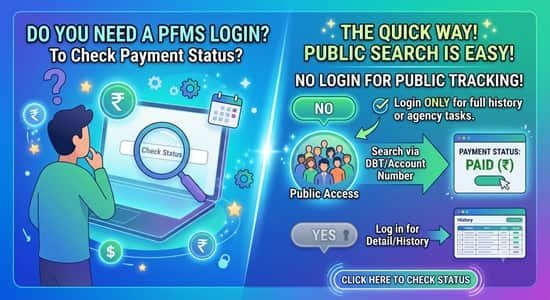
- Look at a past credit on PFMS’s public payment tool. If your account received a government payment through PFMS, it will appear there, usually with the scheme or paying agency named.
- Check the scheme’s portal or guidelines. Most schemes that pay through PFMS mention DBT and PFMS in their payment or FAQ sections.
- Browse DBT Bharat. The portal lists DBT schemes ministry by ministry, which helps confirm whether a scheme is part of the central DBT framework.
If a scheme is run by your state with its own portal, ask the department directly, since some state schemes use their own payment systems instead.
FAQs
Q1. How many schemes use PFMS for payments?
A. DBT Bharat tracks 320 DBT schemes across 56 ministries. PFMS also handles many non-DBT government payments, including salaries, grants, refunds, and other fund transfers.
Q2. Is PM-KISAN paid through PFMS?
A. Yes. PM-KISAN instalments are processed through PFMS after state verification and bank account validation.
Q3. Are PMAY-Gramin instalments paid through PFMS?
A. Yes. Financial assistance under PMAY-Gramin is paid in instalments linked to verified stages of house construction.
Q4. How much does PMMVY pay?
A. PMMVY provides ₹5,000 for the first child in two instalments. For the second child, ₹6,000 is provided if the child is a girl.
Q5. Do government salaries go through PFMS?
A. Yes. Salaries of central civil employees are processed through the Employee Information System of PFMS.
Q6. Are GST refunds paid through PFMS?
A. Yes. GST refunds are paid to eligible businesses through PFMS after successful bank account validation.
Q7. How much has been transferred through DBT so far?
A. The DBT Bharat portal shows cumulative Direct Benefit Transfer payments of more than ₹53.5 lakh crore.
Q8. How can I find out if my state scheme uses PFMS?
A. Check the scheme’s official portal or guidelines, review previous credits through the PFMS payment tracking facility, or contact the government department responsible for running the scheme.