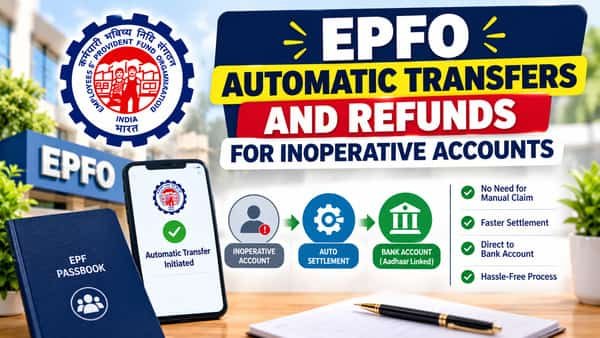
EPFO automatic transfers and refunds for inoperative accounts target a problem worth roughly ₹9,330 crore. That’s the unclaimed balance reportedly sitting in about 30.9 lakh inoperative EPF accounts as of 31 March 2026. Much of it belongs to people who retired, moved abroad or passed away without anyone filing a claim, and to members who simply forgot an account from an early job. In March 2026, EPFO’s Central Board of Trustees approved a pilot to settle the smallest of these automatically, starting with balances of ₹1,000 or less, credited straight to members’ Aadhaar-linked bank accounts. Alongside it, automatic transfers are being rolled out so active members’ old balances follow them to new jobs.
| Particular | Details |
| Inoperative accounts reported | About 30.9 lakh as of 31 March 2026 |
| Unclaimed balance reported | About ₹9,330 crore |
| When an account becomes inoperative | No contribution for 3 continuous years after age 55 or retirement, whichever is later; also after permanent migration abroad or death if unclaimed |
| Interest on inoperative accounts | Not credited |
| Interest for members under 55 without contributions | Continues until age 58 |
| Auto-settlement pilot approved | 239th CBT meeting, 2 March 2026 |
| Pilot balance limit | ₹1,000 or less |
| Phase 1 coverage | About 1.33 lakh accounts, about ₹5.68 crore |
| Where money goes | Aadhaar-seeded bank account linked with EPFO |
| Future phases | Extension to balances above ₹1,000 planned if the pilot succeeds |
| After 7 years unclaimed | Balance moves to the Senior Citizens’ Welfare Fund |
| Claim needed for pilot cases | No |
When an Account Becomes Inoperative
“Inoperative” has a specific meaning in EPF, and it’s narrower than most people think. An account doesn’t go inoperative just because you stopped working for a while.
Under EPF provisions, an account is treated as inoperative when no contribution is received for a continuous period of three years after the member reaches 55 or retires, whichever is later. Similar treatment applies when a member permanently settles abroad or dies, and no claim is filed for that period.
What this means in practice:
- A 32-year-old who left a job and never transferred the balance doesn’t have an inoperative account. It keeps earning interest until the member turns 58.
- A 60-year-old who retired three years ago and never withdrew likely has an inoperative account, with interest stopped.
- A member who passed away years ago, with no claim filed by the family, may have an inoperative account holding PF, and possibly pension and insurance entitlements as well.
Interest: The Real Cost of Forgetting
Once an account turns inoperative, interest stops. That’s the quiet cost of leaving money unclaimed after retirement.
At 8.25%, the rate for FY 2025-26:
| Balance left unclaimed | Interest foregone per year |
| ₹50,000 | About ₹4,125 |
| ₹2,00,000 | About ₹16,500 |
| ₹5,00,000 | About ₹41,250 |
A retiree who leaves ₹5 lakh unclaimed for five years after it turns inoperative misses out on over ₹2 lakh of interest, simply by not filing a claim.
The ₹1,000 Auto-Refund Pilot
At its meeting on 2 March 2026, the CBT approved a pilot for auto-initiation of claim settlement in inoperative accounts with unclaimed balances of ₹1,000 or less.
How it works:
- EPFO identifies eligible inoperative accounts with small balances.
- The claim is initiated by EPFO itself. The member doesn’t have to file anything.
- The money is credited directly to the member’s Aadhaar-seeded bank account linked with EPFO.
Who’s covered first: about 1.33 lakh accounts, together holding nearly ₹5.68 crore, in the first phase. These are accounts where Aadhaar is verified, which makes automatic payment possible.
What comes next: EPFO has said the facility will be extended to accounts with balances above ₹1,000 in later phases, based on how the pilot performs.
What you can do to benefit: keep your Aadhaar verified with EPFO and your bank account Aadhaar-seeded. Automatic refunds can only go where EPFO knows the money will reach the right person.
Automatic Transfers for Active Members
The flip side of inoperative accounts is the many active members with balances scattered across old member IDs. EPFO has been rolling out automatic transfers for members whose UAN is Aadhaar-linked and KYC-complete, so an old employer’s balance can move into the new member ID once fresh contributions start. Where it doesn’t happen automatically, an online transfer request still works.
Consolidating balances matters for inoperative-account risk too. One active account is far less likely to be forgotten than three scattered ones.
What Happens After Seven Years
Money doesn’t sit in an inoperative account forever. If it stays unclaimed for seven years after the account becomes inoperative, it’s transferred to the Senior Citizens’ Welfare Fund, set up under the Finance Act, 2015.
That doesn’t mean the money is lost. Members or their legal heirs can still claim it through EPFO for an extended period, though the process takes longer than a regular claim. Acting before the seven-year mark is far simpler.
How to Find Old or Forgotten Accounts
If you have a UAN:
- Log in to the member portal and check View > Service History for every member ID.
- Open the passbook for each member ID to see balances still sitting there.
- Transfer active balances into your current account, or file a final settlement if you’ve retired.
If you worked before UANs existed:
- Look for old salary slips, PF slips or appointment letters showing a PF account number.
- Contact the former employer’s HR or accounts team with your name, date of birth and period of service.
- Approach the EPFO regional office covering that employer if the company has closed.
If you’re helping family after a member’s death:
- Form 20 is used to claim the PF balance of a deceased member.
- Form 10D covers family pension under EPS.
- Form 5(IF) is used to claim the EDLI insurance benefit.
- Nominees named in the member’s e-nomination usually have the simplest path. Without a nomination, legal heirs may need additional documents.
Claiming an Inoperative Balance Yourself
Don’t wait for auto-settlement if your balance is above ₹1,000 or if you want the money sooner:
- Activate your UAN if you haven’t, through the UMANG app.
- Complete KYC with Aadhaar, PAN and an active bank account in your name.
- Check that old member IDs appear under your UAN, and link or transfer any that don’t.
- File Form 19 for the EPF balance, and Form 10C or 10D for the pension side as applicable.
- Track the claim on the member portal until it’s settled.
For old accounts that can’t be linked online, or where the employer no longer exists, the composite claim form can be filed at the regional office. EPFO allows alternative attestation in cases where the employer isn’t available, so ask the office which officials can attest your form.
A Simple Habit That Prevents All of This
- Keep one UAN and transfer every old balance into your current account.
- File a final claim within a reasonable time after retirement instead of letting the account drift.
- Make sure your nomination is up to date, so your family can claim easily if needed.
- Keep Aadhaar and bank details current, so automatic transfers and refunds can reach you.
FAQs
Q1. When does an EPF account become inoperative?
A. An EPF account generally becomes inoperative when no contribution is received for three continuous years after the member turns 55 or retires, whichever is later, subject to the applicable EPFO rules.
Q2. Do inoperative EPF accounts earn interest?
A. No. Once an EPF account is classified as inoperative under the applicable rules, interest is generally no longer credited to the account.
Q3. Does my old PF account earn interest if I’m under 55?
A. Yes. An old EPF account belonging to a member below 55 years of age may continue earning interest even when contributions have stopped, subject to EPFO rules. Interest may continue up to the applicable age limit.
Q4. What is EPFO’s auto-settlement pilot for inoperative accounts?
A. EPFO’s auto-settlement pilot is designed to automatically settle eligible small-balance inoperative accounts. In the initial phase, accounts with balances of ₹1,000 or less are being targeted for transfer to members’ Aadhaar-linked bank accounts.
Q5. How many accounts are covered in the first phase?
A. The first phase covers approximately 1.33 lakh inoperative EPF accounts, collectively holding nearly ₹5.68 crore.
Q6. Will auto-settlement cover balances above ₹1,000?
A. EPFO plans to consider extending auto-settlement to accounts with higher balances in later phases, depending on the results of the initial pilot.
Q7. What happens to PF unclaimed for seven years?
A. Eligible unclaimed amounts may be transferred to the Senior Citizens’ Welfare Fund after the prescribed period. However, eligible members, nominees, or legal heirs can still make a claim in accordance with the applicable rules.
Q8. How can family members claim PF after a member’s death?
A. Eligible family members or nominees can generally use Form 20 for the EPF balance, Form 10D for eligible family pension benefits, and Form 5(IF) for EDLI insurance benefits, subject to EPFO requirements.