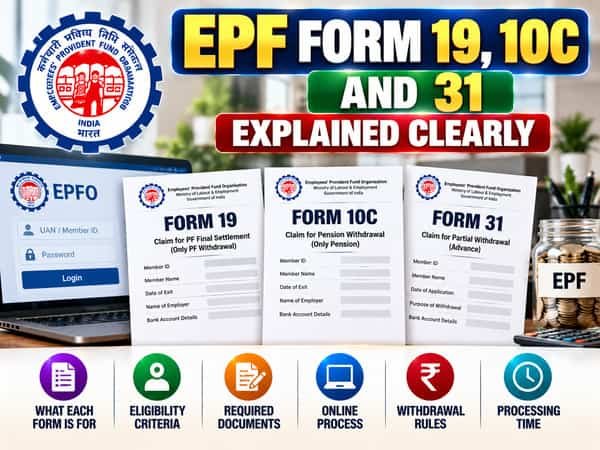
EPF Form 19, 10C and 31 each open a different part of the same PF account, and a member leaving a company after six years might need two of them in the same week. Form 31 lets you draw money while you’re still working. Form 19 closes out your EPF savings once you’ve left covered employment. Form 10C deals with the pension side, either paying out a withdrawal benefit or preserving your pension service for later. Choosing the right one, or the right combination, decides whether money arrives quickly or a claim comes back marked “rejected.”
| Point | Form 31 | Form 19 | Form 10C |
| What it’s for | Partial withdrawal (advance) | Final settlement of EPF | EPS withdrawal benefit or scheme certificate |
| When you use it | While in service or as permitted under the rules | After retirement, or after leaving and meeting the waiting period | After leaving, with less than ten years of pension service |
| Which money it touches | EPF balance (employee and employer shares) | Entire EPF balance with interest | Pension (EPS) entitlement |
| Minimum service | 12 months, under the October 2025 rules | Not a service test; an exit and waiting-period test | Pension service under ten years for the withdrawal benefit |
| Waiting period after leaving | Not applicable while in service | 12 months of unemployment for premature settlement | 36 months for final pension withdrawal |
| Can it be repeated? | Yes, within category limits | No, it closes the account | Once per pension record |
| Typical outcome | Part of the balance paid; account stays open | EPF balance paid; account closes | Lump-sum withdrawal benefit or a scheme certificate |
Form 10D, for completeness, is the claim for a monthly pension once you’re eligible for it.
Form 31: Money While You’re Still Working
Form 31 is the advance form. It’s what you file for medical bills, school or college fees, a family wedding, a home purchase or an emergency, without leaving your job.
How it works now:
- Purposes fall under three categories: essential needs, housing needs and special circumstances.
- You need at least 12 months of service.
- You can withdraw up to 100% of the eligible balance, while 25% of contributions stays in the account as a minimum balance.
- Education can be claimed up to 10 times and marriage up to 5 times.
What it pays from: your EPF balance, meaning the employee and employer shares with interest. It never touches the pension portion.
Points to watch:
- The eligible amount shown on the portal is what you can actually get. Don’t plan around your full passbook total.
- Pick the category that genuinely fits your need.
- Take only what you need now. Money left in EPF keeps earning interest.
Form 19: Closing Your EPF Account
Form 19 is for final settlement. It pays out the whole EPF balance, employee share, employer share and interest, and closes that account.
When it applies:
- On retirement
- After leaving covered employment and staying out of it for 12 months, under the rules approved in October 2025
- In other situations permitted under the scheme
What it doesn’t do: Form 19 doesn’t pay anything from the pension side. If you also want to settle your EPS entitlement, you need Form 10C or 10D as well.
Before filing:
- Your date of exit must be recorded against the last member ID.
- If you’ve changed jobs before, transfer older balances into one member ID first, or you’ll be settling only part of your money.
- Check whether the withdrawal could attract TDS, especially with less than five years of continuous service. If your income is below the taxable limit, the portal may let you submit a declaration to avoid deduction.
Form 10C: The Pension Side When You Leave Early
Form 10C is the least understood of the three, because it offers two different outcomes:
- Withdrawal benefit: a one-time payment from your pension entitlement, calculated using your years of service and pensionable wages through a table in the pension scheme.
- Scheme certificate: a document that records your pension service and wages, so they can be carried into a future job and count towards a pension later.
The ten-year line matters most:
- With less than ten years of pension service, you can choose either option.
- With ten years or more, you can’t take a withdrawal benefit. Your service already qualifies you for a pension, so the scheme certificate route applies until you claim pension.
- Under EPS rounding, service of six months or more in a final year is usually rounded up. Someone with 9 years and 6 months of service is often treated as having ten years, which can make them pension-eligible rather than eligible for a withdrawal benefit.
The waiting period: final pension withdrawal now needs 36 months after leaving employment.
Which option is better? If there’s a real chance you’ll return to EPF-covered work, the scheme certificate usually serves you better, since it keeps your path to a lifelong pension open. The withdrawal benefit is a modest one-time amount by comparison.
Filing Form 19 and 10C Together
When someone leaves salaried work for good, or for a long stretch, the usual combination is:
- Form 19 for the EPF balance
- Form 10C for the pension entitlement
Both can be filed online once the waiting periods are met and KYC is complete. They’re processed as separate claims, so the two payments can arrive on different days with different amounts. A passbook will show the EPF settlement as a debit, while the pension withdrawal appears against your pension record.
Online Claims and Offline Composite Forms
Most members now file all three forms online through the member portal, verified with an Aadhaar OTP. For those who can’t, EPFO offers composite claim forms for offline filing:
- Composite Claim Form (Aadhaar): for members whose UAN is linked with Aadhaar and bank details. It can generally be submitted directly to the EPFO office without the employer’s attestation.
- Composite Claim Form (Non-Aadhaar): for members without Aadhaar seeding. It needs the employer’s attestation before submission.
Each composite form covers several claim types, so you tick the boxes for the forms you need, such as 19 and 10C together.
Which Form Fits Your Situation?
| Your situation | Form to use |
| Employed, need money for a child’s college fees | Form 31 |
| Employed, medical emergency in the family | Form 31 |
| Changed jobs, joined a new employer right away | No withdrawal; transfer your balance |
| Left work, not working for over 12 months, want EPF settled | Form 19 |
| Left work with 6 years of pension service, not returning for 3+ years | Form 19 plus Form 10C (withdrawal benefit) |
| Left work with 6 years of service, may return later | Form 19 if needed, plus Form 10C (scheme certificate) |
| Retired at 58 with 12 years of service | Form 19 plus Form 10D for monthly pension |
| Retired at 58 with 7 years of service | Form 19 plus Form 10C (withdrawal benefit) |
Mistakes That Cost Time
- Filing Form 19 while still employed. It’s for final settlement, not advances.
- Using Form 31 after leaving, when the situation calls for final settlement.
- Forgetting Form 10C and assuming Form 19 pays everything.
- Settling only one member ID when older balances weren’t transferred.
- Taking a withdrawal benefit just short of ten years, when a scheme certificate could have kept a pension within reach.
- Filing before the waiting period ends, which leads to rejection.
- Missing date of exit, the most common reason Form 19 and 10C claims fail.
FAQs
Q1. What is EPF Form 31 used for?
A. EPF Form 31 is used to claim a partial withdrawal or advance from your EPF balance while you are still in service, subject to the applicable eligibility conditions.
Q2. What is Form 19 in EPF?
A. Form 19 is used for the final settlement of your EPF balance after retirement or after leaving employment and satisfying the applicable waiting-period requirements.
Q3. What is Form 10C in EPF?
A. Form 10C is used to claim an EPS withdrawal benefit or obtain a Scheme Certificate, depending on the member’s eligible pension service. A withdrawal benefit is generally relevant when eligible service is less than 10 years.
Q4. Can I file Form 19 and Form 10C together?
A. Yes. Eligible members commonly submit Form 19 and Form 10C together after leaving employment. Form 19 deals with the EPF balance, while Form 10C deals with the applicable EPS pension entitlement.
Q5. Does Form 19 include my pension amount?
A. No. Form 19 settles only the EPF balance. EPS pension-related claims are handled separately through Form 10C or Form 10D, depending on eligibility.
Q6. Can I withdraw my pension benefit with 10 years of service?
A. Generally, once a member has completed 10 years or more of eligible EPS service, the pension benefit cannot be withdrawn as a lump-sum withdrawal benefit. The pensionable service is instead preserved for monthly pension eligibility under the EPS rules.
Q7. What is a Scheme Certificate in EPF?
A. A Scheme Certificate records your eligible pension service and related details under EPS. It helps preserve past pensionable service so that it can be counted with eligible service from future employment.
Q8. Can I fill Form 19, Form 10C or Form 31 offline?
A. Yes. Eligible claims can also be submitted offline using the applicable Composite Claim Form (Aadhaar or Non-Aadhaar) through the EPFO, subject to the required documentation and verification.