How to check old age pension payment status on PFMS starts with a number most pensioners never see in their passbook: ₹200. That’s the central government’s monthly share under the Indira Gandhi National Old Age Pension Scheme (IGNOAPS) for people aged 60 to 79, rising to ₹500 at 80. The amount actually credited is usually much higher, because states add their own money on top, and some states run the pension entirely as their own scheme. That mix decides where your records sit and which portal shows what. This guide explains the three places to check, in the order that makes sense, along with tips for family members helping an elderly pensioner.
| Particular | Details |
| Central scheme | Indira Gandhi National Old Age Pension Scheme (IGNOAPS) |
| Parent programme | National Social Assistance Programme (NSAP), launched in 1995 |
| Ministry | Ministry of Rural Development |
| Eligibility (central) | Age 60 and above, from a Below Poverty Line household |
| Central share, age 60–79 | ₹200 per month |
| Central share, age 80+ | ₹500 per month |
| Last revision of central amount | 2011, when the age limit was lowered from 65 to 60 and the 80+ amount raised to ₹500 |
| State share | Added by each state; varies widely |
| Central portal | nsap.nic.in |
| Mobile option | UMANG app, NSAP service |
| Payment mode | DBT to bank or post office account |
| Final credit check | PFMS public payment tools or bank passbook |
What Your Monthly Amount Is Made Of
Pensions under NSAP were designed as a central floor that states build on. States were asked to add at least an equal amount from their own funds, and most add much more, so total old age pensions vary from a few hundred rupees in some states to several thousand in others.
This matters when checking status because:
- The central share may be paid together with the state share as one credit, or separately, depending on how your state handles it.
- Some states have merged IGNOAPS into their own pension scheme, paying the full amount through a state system. In these states, the state portal is the main record.
- Eligibility for the state top-up can differ from central rules, so a person may receive a state pension even if not counted under IGNOAPS.
If the amount credited looks different from what a neighbour receives, the difference often comes from age slabs or state rules rather than an error.
Where Old Age Pension Records Live
| Portal | What it shows | Best for |
| State pension portal | Application, sanction, verification and state payments | Checking whether you’re an active beneficiary |
| NSAP portal (nsap.nic.in) | Central scheme beneficiary details and pension payment records | Checking central scheme status and payment details |
| PFMS | Government credits to your bank account | Confirming the money actually arrived |
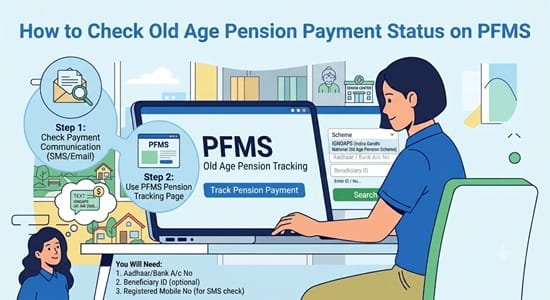
Check in this order. If you’re not active on the state or NSAP record, PFMS won’t have anything to show.
Step 1: Find Your Beneficiary Record on NSAP
- Open nsap.nic.in.
- Go to the Reports section on the homepage.
- Look for the beneficiary search or pension payment details
- Select your state, district and block or urban area, if asked.
- Search using one of the available options, such as application number, sanction order number, bank account number or name.
- Review your record, including scheme name, sanction details and payment entries where available.
Your sanction order number is printed on the pension sanction letter issued when you were approved. If you don’t have it, the block office or urban local body that processed your application can share it.
Step 2: Check Your State’s Pension Portal
Most states run their own social pension portals, often under the Social Welfare or Rural Development department. For example, Uttar Pradesh uses sspy-up.gov.in and Bihar uses the E-Labharthi portal. These portals usually let you:
- Search by application number, Aadhaar or bank account
- See whether you’re an active, suspended or rejected beneficiary
- View month-wise or quarter-wise payment details for the state’s share
If your state portal shows you as active and paid, but the money isn’t in your account, move to Step 3.
Step 3: Confirm the Credit on PFMS
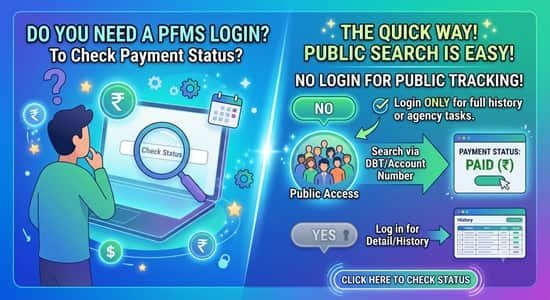
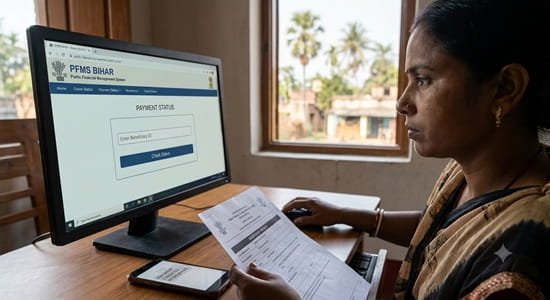
Use PFMS’s public Know Your Payments tool with the bank name and account number where the pension is credited. It lists government payments to that account and confirms whether the pension reached the bank.
If the pension is paid into a post office account, the same check applies, since post office savings accounts are part of the PFMS network.
Checking Through the UMANG App
For pensioners or family members who prefer a phone, the UMANG app offers an NSAP service. It lets applicants check application status and view beneficiary payment details wherever these are available. It’s a handy option for people without regular computer access, though the data shown is the same as on the NSAP portal.
For Family Members Helping an Elderly Pensioner
Many old age pensioners rely on children or neighbours to check payments. A few practical tips:
- Keep the sanction letter and passbook together in one folder, with the pension ID written on the cover.
- Check which mobile number is registered with the bank. OTPs for payment checks go there, so it should be a phone the pensioner or a trusted family member can access.
- Update the passbook regularly. A printed record is the easiest proof when following up with the block office.
- Use doorstep or bank mitra services when travel is hard. The RBI has asked banks to offer doorstep banking to senior citizens above 70, and bank mitras can help with balance checks in villages.
- Never share OTPs with callers claiming to be from the pension department.
Why an Old Age Pension Stops
When a pension that used to arrive regularly suddenly stops, the cause is often one of these:
- Annual verification not completed. Many states require pensioners to confirm they’re alive and eligible each year, through physical verification or Aadhaar-based authentication.
- Wrongly marked as deceased. Data errors sometimes mark living pensioners as dead. This needs a correction request with proof of life at the block or district social welfare office.
- Beneficiary list revised. A change in BPL or eligibility records can drop names, sometimes by mistake.
- Aadhaar or e-KYC pending. Some states pause payments until Aadhaar is seeded or e-KYC is done.
- Bank account unused for a long time. Accounts with no customer activity for a long period can become inoperative. Regular small transactions help keep it active.
Start with the block development office, urban local body or district social welfare office, depending on where you applied. Carry the sanction letter, Aadhaar, passbook and a recent photograph.
If a Pensioner Passes Away
Family members should inform the block office or urban local body promptly so the pension is stopped. Amounts credited after the date of death can be recovered later, which creates avoidable trouble for the family. Getting the death recorded early also makes it easier to close the account and settle any other dues.
FAQs
Q1. How much is the central old age pension under IGNOAPS?
A: The central share is ₹200 per month for ages 60 to 79 and ₹500 per month for those 80 and above.
Q2. Why is my old age pension more than ₹200?
A: Your state adds its own top-up to the central share, so the total credited is usually higher.
Q3. Where can I check my old age pension status online?
A: Check the NSAP portal or your state’s pension portal first, then confirm the credit on PFMS.
Q4. What details do I need to search on the NSAP portal?
A: You can usually search with your application number, sanction order number, bank account number or name.
Q5. Can I check old age pension status on my phone?
A: Yes, through the UMANG app’s NSAP service or the PFMS and NSAP websites on a phone browser.
Q6. Why did my old age pension suddenly stop?
A: Common reasons include missed annual verification, wrong death records, list revisions or pending Aadhaar seeding.
Q7. Can old age pension be paid into a post office account?
A: Yes, pensions can be credited to post office savings accounts.
Q8. What should the family do if a pensioner dies?
A: Inform the block office or urban local body promptly so payments stop and no recovery is needed later.