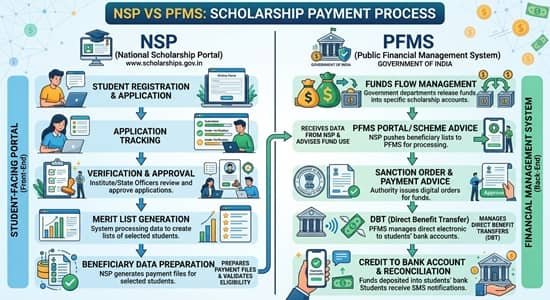
NSP vs PFMS confusion usually surfaces at one moment: a student sees “sanctioned” on one portal and nothing at all on the other. That gap makes sense once you know the two systems do completely different jobs. The National Scholarship Portal (NSP) is where a scholarship is applied for, verified and approved. The Public Financial Management System (PFMS) is where the approved money is checked against your bank account and actually paid. They pass data back and forth, but neither can do the other’s work. This guide sets out what each one does, where the handover happens, and which portal owns which problem.
| Point of comparison | NSP | PFMS |
| Full name | National Scholarship Portal | Public Financial Management System |
| Website | scholarships.gov.in | pfms.nic.in |
| Nodal ministry | Ministry of Electronics and Information Technology | Ministry of Finance (Controller General of Accounts) |
| Built by | National Informatics Centre | Office of the CGA, with NIC support |
| Operational since | 1 July 2015, under the Digital India programme | 2009, as a fund tracking system |
| Framework | Mission Mode Project under the National e-Governance Plan | Government payment and accounting platform |
| Schemes covered | 140+ scholarships from central ministries, states, UGC and AICTE | All kinds of government payments, scholarships being one |
| Student login | Yes, with OTR number | No |
| Main job | Application, verification and sanction | Bank validation, payment and status reporting |
| Decides eligibility? | Yes, through verification and scheme rules | No |
| Moves money? | No | Yes |
| Student’s ID here | OTR number and application ID | Beneficiary code |
What NSP Does
NSP is a single window for scholarships that used to have separate application systems. Its official vision describes a simplified, accountable and transparent system for quick disposal of applications and delivery of funds directly to beneficiaries. In practice, it handles:
- One application for many schemes. Students fill one integrated form instead of separate forms for every ministry.
- Scheme suggestions. Based on what you enter, the portal suggests the scholarships you’re eligible for.
- Master data for institutions and courses. A common list of institutions and courses across India keeps data consistent.
- Duplicate checks. The portal is designed to reduce duplicate applications as far as possible.
- Multi-level verification. Institutes and nodal officers verify applications before they reach the scheme’s ministry.
- Sanction by the ministry. The ministry or department that owns the scheme approves eligible students.
- Decision support for ministries. Up-to-date data helps ministries plan and track schemes.
NSP covers students from Class 1 up to PhD, depending on the scheme.
What PFMS Does in a Scholarship
PFMS treats NSP as an external system that sends it payment requests. Once a ministry sanctions a batch of students, PFMS:
- Receives the sanctioned list from NSP with each student’s payment details.
- Validates each bank account with the student’s bank before any money moves.
- Processes the payment through the ministry’s accounting and payment chain.
- Returns status updates to NSP, so the scholarship portal can reflect validation and payment results.
- Offers public tracking, so students can follow the payment without logging in.
PFMS doesn’t look at marks, income certificates or attendance. If a student is on the sanctioned list, PFMS’s only question is whether the money can be paid into the account provided.
The Handover: Where NSP Ends and PFMS Begins
The handover point is the sanctioned beneficiary list. Everything before sanction belongs to NSP. Everything after belongs to PFMS and the banks.
Data moves in both directions:
| Direction | What travels |
| NSP to PFMS | Sanctioned student details, scheme, amount, and bank or Aadhaar details for payment |
| PFMS to NSP | Bank validation result for each student |
| PFMS to NSP | Payment status after the bank responds |
This two-way flow is why a student can sometimes see payment updates on both portals. NSP shows the result PFMS sends back; PFMS shows the same result from its own records.
Same Student, Different IDs
A scholarship student ends up with several identifiers, each belonging to a different system:
| ID | Issued by | Used for |
| OTR number | NSP | Logging in and applying for all NSP scholarships |
| Application ID | NSP | Tracking one scholarship application for one year |
| Beneficiary code | PFMS | Identifying you in PFMS after your account is validated |
| Transaction reference | Your bank | Tracing a specific credit in your account |
Keep all four in one place. When you contact a helpdesk, quoting the ID that belongs to that system saves time.
Which Portal Owns Your Problem
| Problem | Owner | First contact |
| OTR or face authentication failing | NSP | NSP helpdesk |
| Application marked defective | NSP | Institute scholarship cell |
| Stuck at institute or nodal officer level | NSP | Institute, then district or state nodal officer |
| Not eligible or rejected by scheme | NSP | Scheme’s ministry or helpline |
| Bank validation failed | PFMS, with your bank | Your bank, then the scheme to update details |
| Payment failed after release | PFMS, with your bank | Your bank, then the scheme to re-issue |
| Amount different from expected | Scheme ministry | Scheme helpline |
| Payment shown as done but not visible | Your bank | Bank branch, using the transaction reference |
A rule of thumb: anything about whether you qualify belongs to NSP. Anything about whether money reached your account belongs to PFMS and your bank.
Changing Your Bank Account: The Common Cross-Portal Trap
Bank details travel from NSP to PFMS, not the other way round. So if you close your old account or open a new one, updating your bank alone may not be enough.
- For account-based payments, PFMS will keep trying the details NSP sent. Ask your institute or the NSP helpdesk how to update bank details on your application, and do it before the next payment cycle.
- For Aadhaar-based payments, mapping your Aadhaar to the new account at your bank is usually enough, since PFMS routes the money through Aadhaar rather than the account number on file.
If you’re not sure which mode your scheme uses, ask the institute’s scholarship cell before closing any account.
NSP Isn’t the Only Front Door
PFMS sits behind many scholarship portals, not just NSP. Several states run their own scholarship systems that feed sanctioned students into PFMS in a similar way. So the NSP-and-PFMS pattern applies more widely: one portal decides who qualifies, and PFMS handles the payment.
FAQs
Q1. What is the difference between NSP and PFMS?
A: NSP handles scholarship applications, verification and sanction, while PFMS validates bank accounts and pays the sanctioned amount.
Q2. Which ministry runs the National Scholarship Portal?
A: NSP is a Mission Mode Project under the Ministry of Electronics and Information Technology, developed by the National Informatics Centre.
Q3. When did the National Scholarship Portal start?
A: NSP became operational on 1 July 2015 under the Digital India programme.
Q4. How many scholarship schemes are on NSP?
A: NSP hosts more than 140 scholarship schemes from central ministries, states, UGC and AICTE.
Q5. Does PFMS decide who gets a scholarship?
A: No, eligibility and sanction are handled on NSP by institutes, nodal officers and the scheme’s ministry.
Q6. Why does NSP show sanctioned but PFMS shows nothing?
A: The sanctioned list may not have reached PFMS yet, or bank validation may still be in progress.
Q7. Do I need a PFMS login to track my scholarship?
A: No, students track scholarship payments on PFMS through public tools without any login.
Q8. What should I do if I change my bank account after applying on NSP?
A: Ask your institute or NSP helpdesk how to update bank details, or re-map Aadhaar if your scheme pays through Aadhaar.