PFMS training resources include something many new users never hear about: free online sessions run by PFMS headquarters every month on Cisco Webex, each focused on a single module. Add to that structured courses at the CGA’s training institute, self-paced lessons on the iGOT Karmayogi platform, manuals on the portal and state-level support teams, and there’s more help available than most new users realise. The challenge is finding the right resource for your role. This guide maps out each option, shows which modules suit which jobs, and ends with a simple 30-day plan for someone new to PFMS.
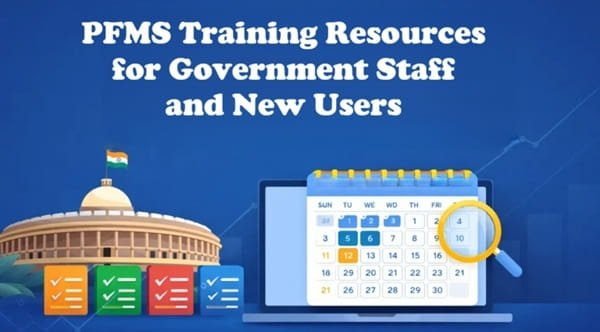
| Resource | Run by | Best for | Format |
| Monthly PFMS online training | PFMS headquarters, Office of the CGA | Module-specific skills for agencies, ministries and PAOs | Live sessions on Cisco Webex |
| PFMS Training Cell | Office of the CGA | Questions about training schedules | Email: training-pfms@gov.in |
| INGAF courses | Institute of Government Accounts and Finance | Structured accounting and finance training | Classroom and online |
| iGOT Karmayogi | Department of Personnel and Training | Self-paced learning with certificates | Online and mobile app |
| Manuals and circulars | PFMS portal | Step-by-step reference | Downloadable documents |
| State support teams | State PFMS units and SPMUs | Hands-on help for agencies in the state | Workshops and helpdesk |
Monthly Online Training From PFMS Headquarters
Every month, the Office of the CGA issues an Office Memorandum with a schedule of online PFMS training sessions. They’re held on Cisco Webex, typically from 10:30 am, and are open to central ministries and departments, autonomous bodies, state government agencies and all implementing agencies working on PFMS.
Each session covers one module, taught by PFMS headquarters staff or the GIFMIS team. Recent schedules give a sense of the range:
| Module | Who it’s for | What it covers |
| EAT (Expenditure, Advance and Transfer) | Implementing agencies receiving grants | Receiving funds, filing expenditure, advances and settlement, transfers to lower agencies |
| TSA Hybrid | Autonomous bodies, state agencies, CPSEs | Routing funds through RBI, DSC use, processes, do’s and don’ts |
| CNA Model-II | Ministry officials and agencies under CNA | Implementing CNA for central sector schemes |
| e-Bill | Ministry officials, Principal Accounts Offices, PAOs | Implementing the e-Bill module |
| DBT | Newly joined State Project Management Unit staff | Configuring and paying DBT through various modes |
| Interest remittance | DDOs and implementing agencies | Remitting interest earned on CNA and SNA accounts to the Consolidated Fund of India |
How to join: The schedule and meeting details are circulated through ministries, departments and state teams. If yours hasn’t reached you, ask your nodal officer or write to the PFMS Training Cell at training-pfms@gov.in.
Match the Module to Your Role
New users often attend whatever session comes up first. Starting with the module tied to your daily work gets you productive faster.
| Your role | Start with | Add later |
| Implementing agency accountant | EAT | Interest remittance, DBT if you pay beneficiaries |
| Autonomous body finance staff | TSA Hybrid | EAT for grant utilisation |
| Ministry programme division | CNA Model-II | e-Bill, sanction-related sessions |
| Pay and Accounts Office staff | e-Bill | TSA and CNA, to understand agency-side flows |
| State Project Management Unit staff | DBT | EAT and SNA-related sessions |
| DDO or office head | Interest remittance | e-Bill, EIS for salary processing |
Even if a session seems outside your role, sitting through one on the “other side” of a process, like a PAO officer attending EAT, helps you understand why the people you work with send the queries they do.
INGAF: Structured Courses for Accounts Staff
The Institute of Government Accounts and Finance is the CGA’s training arm. It trains Indian Civil Accounts Service officers and accounts staff in government accounting, financial rules and systems including PFMS, through its centre in New Delhi and regional training centres.
INGAF also trains people from other organisations. EPFO’s direct-recruit Enforcement Officers and Accounts Officers, for example, spend two weeks at INGAF during induction to understand balance sheets and financial statements in the context of their work.
For staff whose job involves accounting rules as well as PFMS screens, INGAF programmes provide the grounding that short online sessions can’t.
iGOT Karmayogi: Self-Paced Learning
Under Mission Karmayogi, government employees can take online courses on the iGOT Karmayogi platform at their own pace. INGAF has developed courses on financial rules, such as the FRSR series, which are hosted there.
In July 2024, the CGA issued an Office Memorandum shortlisting iGOT courses for ICAS officers, Senior Accounts Officers and Assistant Accounts Officers, encouraging them to complete courses relevant to their functional roles.
A few practical points:
- Registration happens through your organisation, with sign-in by email or mobile OTP.
- Certificates are generated automatically after you complete a course and pass its assessment.
- The iGOT Karmayogi app lets you study on a phone, including downloaded content for offline use.
Manuals and Circulars on the Portal
The PFMS portal hosts user manuals, guides and circulars, many under its What’s New section. These are the best reference when you’re actually doing a task, since they show screens and steps in order.
Two habits help:
- Note the date or version on any manual you download. PFMS changes regularly, and an older guide may show screens that no longer exist.
- Read circulars along with manuals. A manual tells you how a screen works; a circular often tells you why a rule changed or a new step was added.
State-Level Help: SPMUs and State Teams
For state agencies and implementing bodies, help is often closest at state level. State Project Management Units and state PFMS teams support agencies with registration, scheme configuration, DBT set-up and day-to-day problems. PFMS headquarters runs dedicated DBT training for newly joined SPMU staff, so these teams are well placed to answer practical questions in your local context.
Ask your scheme’s nodal officer for the state team’s contact. Many issues that seem complex on a first attempt take minutes for someone who handles them daily.
A 30-Day Plan for a New PFMS User
Week 1: Get set up.
Get your user ID registered and approved, log in successfully, and check your profile details. Read the manual for your main module once, end to end, without trying to do anything yet.
Week 2: Attend the right session.
Join the monthly online training for your core module. Keep your login open alongside so you can follow the screens.
Week 3: Practise under supervision.
Prepare real entries as maker while a senior colleague checks them. If you’ll approve transactions, get your DSC enrolled and approved this week.
Week 4: Learn the checks.
Learn to read the reports your role relies on, such as pending payments, expenditure filed or balances. Note down recurring questions and send them to your state team or the Training Cell.
By the end of the month, you’ll know your core tasks, who to ask for help, and which session to attend next.
Getting More From a Training Session
- Prepare two or three specific questions from your actual work before the session.
- Have your PFMS login ready in another window to follow along.
- Keep the Office Memorandum number of the schedule handy for reference.
- Share notes with colleagues who couldn’t attend, especially on rule changes.
FAQs
Q1. Does PFMS offer free training for government staff?
A. Yes. PFMS headquarters conducts free monthly online training sessions through Cisco Webex for ministries, agencies, and other PFMS users.
Q2. How can I find the PFMS training schedule?
A. PFMS training schedules are generally issued every month through Office Memoranda and circulated through ministries, departments, and state PFMS teams.
Q3. What is the email of the PFMS Training Cell?
A. The PFMS Training Cell can be contacted at training-pfms@gov.in.
Q4. Which PFMS training should implementing agencies attend first?
A. Implementing agencies should generally begin with training on the EAT module, which covers important functions such as fund receipts, expenditure filing, and fund transfers.
Q5. What is INGAF?
A. INGAF stands for the Institute of Government Accounts and Finance. It is the training institute of the Controller General of Accounts (CGA).
Q6. Are PFMS-related courses available on iGOT Karmayogi?
A. Yes. iGOT Karmayogi hosts finance and accounts courses, including courses developed by INGAF. Eligible learners can receive certificates after successfully completing applicable courses.
Q7. Who helps state agencies with PFMS problems?
A. State Project Management Units and state PFMS teams assist agencies with matters such as registration, DBT setup, and routine PFMS-related issues.
Q8. How long does it take to learn PFMS?
A. A new user can typically learn the core PFMS tasks relevant to their role within about a month with formal training, manuals, and supervised practical experience.